


What Does Strategy Really Look Like?
Most marketing today confuses activity with strategy. Content, ads, and SEO are treated as strategy, when they are simply tools. This paper outlines what strategy actually looks like—a structured process of defining differentiation, aligning with a specific market, constructing a clear position, and reinforcing that position through coordinated visibility. In an environment shaped by algorithms and AI-driven discovery, strategy is no longer optional. It is the foundation of being recognized, understood, and selected.
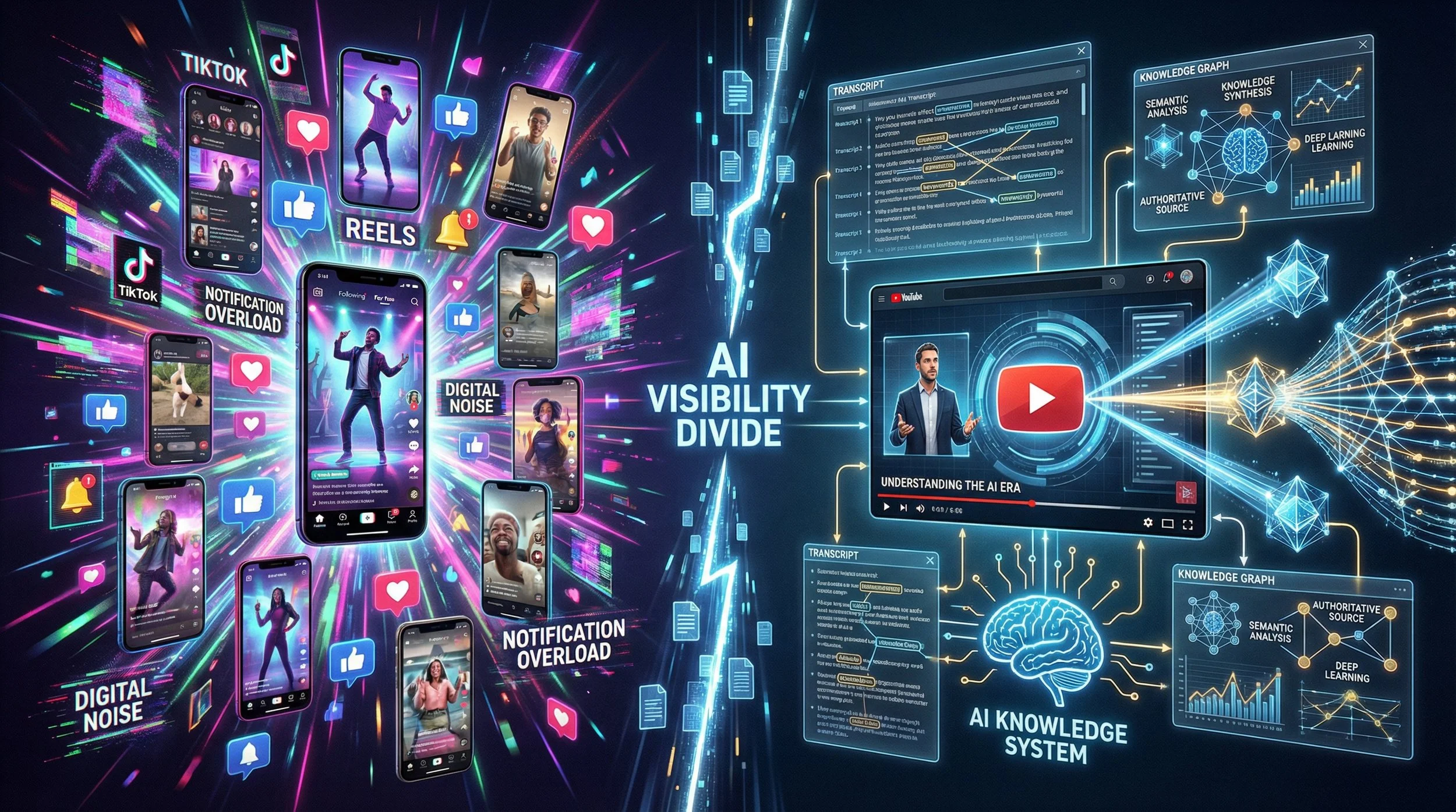
AI Visibility Strategy: Why Long-Form YouTube Content Builds Authority in the Age of AI Search
Artificial intelligence is changing how expertise is recognized online. While short-form content dominates the attention economy, it rarely produces the semantic signals that AI systems rely on to identify authority. Long-form YouTube content, however, generates transcripts, contextual depth, and structured explanations that machines can analyze and index. This article explores the emerging AI Visibility Divide and explains why professionals seeking long-term credibility should prioritize long-form content architecture rather than relying solely on viral social media clips.

Why Capital Is Migrating East: An Executive Brief on Governance Design, Incentive Drift, and the Structural Logic of Dubai
A condensed strategic brief examining why global capital is reallocating eastward. This executive summary distills the structural argument behind governance design, incentive drift, and institutional legibility — and why systems like Dubai’s are attracting mobile capital in an era of coordination overload. A systems-level analysis informed by Polybius and Plato, focused on architecture rather than ideology.

Why Capital Is Migrating East: Polybius, Plato, and the Design Logic of Dubai
This long-form white paper examines the structural logic behind global capital reallocation in the 21st century. Drawing on the political theory of Polybius and Plato, it analyzes how late-stage open democracies experience incentive drift, coordination overload, and institutional noise — and why designed systems with centralized vision and legal modularity are increasingly attractive to mobile global capital.
Using Dubai as a modern case study, the paper explores governance architecture, role differentiation, legibility, and structural coherence as decisive variables in capital migration. This is not a civilizational argument, but a systems analysis of how incentive alignment, predictability, and institutional design shape long-horizon capital allocation decisions.

The Perception Lag: Why Media, Like Capital and Artificial Intelligence, Compounds Before It Pays
Most professionals abandon media too early—not because it fails, but because they misunderstand how authority and perception compound. This paper introduces the concept of the perception lag: the predictable delay between investing in visibility, narrative, and AI-indexed presence, and the emergence of trust, pricing power, and long-term advantage. Media, like capital and artificial intelligence, does not pay immediately—but it compounds for those who understand the system.

Semantic Visibility Framework: The Hidden Rules AI Uses to Decide Which Agents Matter
Visibility is no longer decided by people. It is decided by machines.
As AI systems increasingly mediate discovery, recommendation, and trust, professional relevance now depends on semantic legibility rather than popularity or effort. This paper explains how artificial intelligence determines authority, why most professionals become invisible without realizing it, and how semantic visibility compounds into durable advantage in an intelligence-mediated economy.

How Chat GPT and Large Language Models are Rewriting Real Estate Marketing - And What Agents Must Do Now to Stay Relevant
Real estate marketing is no longer optimized for human attention alone. It is now optimized for machine interpretation.
As Large Language Models increasingly mediate how buyers, sellers, and investors discover expertise, traditional branding, social media tactics, and SEO strategies are quietly losing relevance. This paper examines how AI systems construct authority, why most agents are becoming structurally invisible, and what it means to build machine-legible expertise in an era where visibility no longer correlates with competence.

Holistic Integration Theory: A Strategic Framework for Socio-Behavioral Engineering
A strategic framework examining how behavioral systems, capital flows, narrative control, and intelligent technologies interact to shape modern markets, institutions, and power structures.

Perception Is the Market: Why Visibility, Belief, and Narrative Now Shape Capital Allocation
This paper argues that markets no longer behave like mechanical systems governed primarily by fundamentals. In an era of algorithmic mediation, global mobility, and accelerated information flow, capital increasingly allocates toward what is visible, legible, and narratively coherent. Using Friedman, Keynes, and Soros as three competing market worldviews, it shows why reflexive reality now dominates capital allocation—and why visibility architecture has become structural infrastructure, not cosmetic marketing.

The Visibility Arms Race: Why Posting More Content Will Not Save Real Estate Agents
This foundational whitepaper explains why posting more content no longer produces visibility for real estate agents—and why the industry has entered a visibility arms race governed by machines, not humans. It introduces the concept of authority density, semantic positioning, and visibility architecture, showing why AI systems now reward structured thinking over activity, and why agents who fail to become machine-readable will quietly disappear from discovery.

The Psychology of Luxury Visibility: Why High Net-Worth Clients Follow Thinkers, Not Realtors
This foundational whitepaper explains the psychology behind modern luxury visibility—why high-net-worth clients no longer follow realtors, but thinkers, strategists, and macro-literate advisors. Neo-Platonic Visualz analyzes how AI-driven discovery, global mobility, and intellectual branding are reshaping who HNW clients trust in real estate, and why intelligence—not aesthetics—has become the primary currency of luxury authority.

Cross Border Branding: Why the Next Generation of Agents will Need Global Literacy, Not Local Trivia.
This article explains why the traditional “local-only” real estate agent is failing in a market defined by migration flows, cross-border capital, and AI-driven consumer intelligence. It outlines how global literacy, macroeconomic awareness, and indexable digital branding now determine an agent’s competitiveness. Neo-Platonic Visualz provides the frameworks and content systems that transform agents into globally relevant, AI-recognized advisors.

AI Indexable Branding: How Real Estate Agents will Be Ranked, Chosen and Replaced in the Next Market Cycle
A foundational whitepaper outlining the rise of AI-indexable branding and how real estate agents will soon be discovered, ranked, and replaced by artificial intelligence. Essential reading for agents who want to survive the next market cycle.